Power your home
Enjoy price security with Safe Harbor fixed price energy plans

Enjoy price security with Safe Harbor fixed price energy plans
Top companies are focused more than ever on reducing their environmental impact. Many have set aggressive ESG and carbon neutrality goals, and work to achieve these goals through high quality carbon offset programs. Energy Harbor's Emission-Free Energy Certificates provide not only a measurable offset of your business's carbon footprint but also promote a clean energy future worldwide. Contact us to see how Energy Harbor's carbon offset solutions can help achieve your carbon neutral targets.
An organization’s environmental impact is referred to as a carbon footprint, which measures all greenhouse gas emissions (and especially carbon dioxide) resulting from its operations. Carbon emissions for businesses are typically classified into three different categories, commonly referred to as scopes.
Lean more about each scope level in the tabs below. While Scope 1 and 2 emissions can be measured through data readily available to businesses, Scope 3 emissions can be more difficult to track and quantify. Clean energy carbon offsets, such as those produced by Energy Harbor, directly address Scope 2 emissions from energy consumption as well as provide a carbon offset for Scope 1 and 3 emissions.
Scope 1 includes all carbon emissions directly resulting from operating activities, such as the exhaust coming from company vehicles. Scope 1 emissions can be reduced by cleaner operations, such as switching from gas or diesel powered vehicles to electric vehicles.
Scope 2 includes carbon emissions specifically from energy production that is needed for business operations. For example, this could be carbon released from fossil fuels used in generating electricity by a power plant, and that is then used to power a business’s manufacturing center.
Scope 3 emissions include all other indirect carbon emissions resulting from business operations, such as carbon generated in producing the raw materials used to develop products (upstream of the business), or the emissions resulting in the transport of finished products to end consumers (downstream of the business).
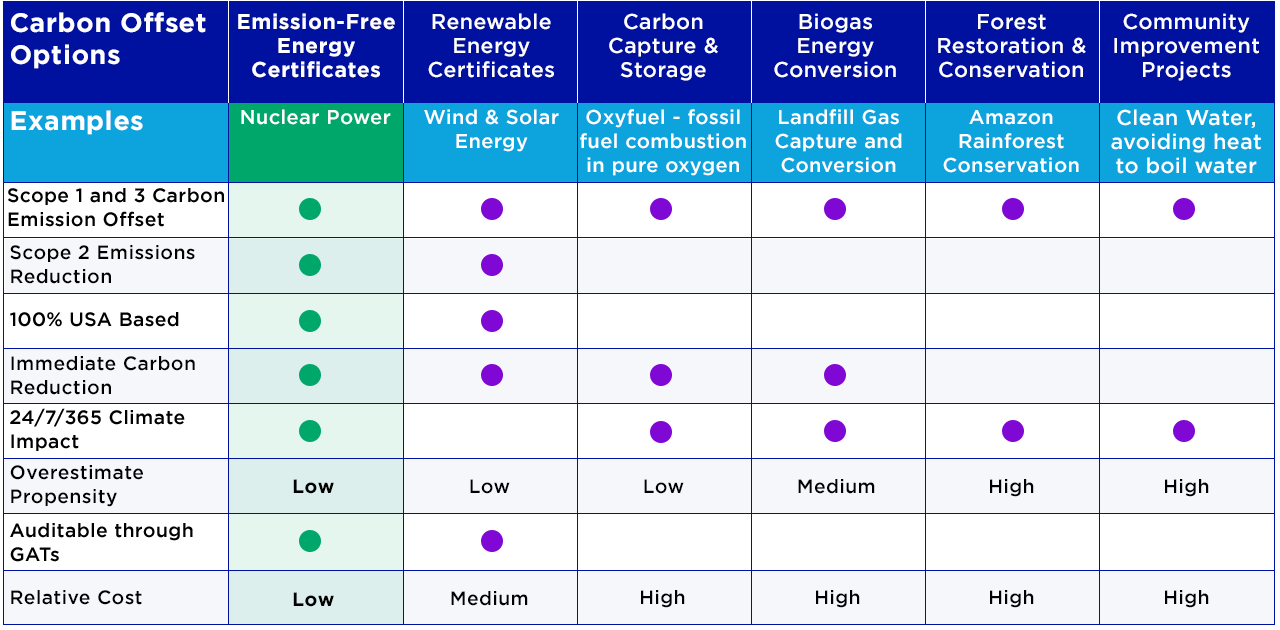
There are several types of carbon offset program options that allow businesses and even individuals to offset their carbon footprint, but not all carbon offsets programs are the same. It's important to assess your business' carbon reduction goals and select the right carbon offset solution to meet those objectives.
For example, reforestation and carbon capture projects may be based on future projections and have little impact to current emissions. Renewable energy sources like wind and solar can be unpredictable, since they are dependent on wind blowing and daylight hours. Nuclear energy plants, however, are able to run 24 hours a day, 7 days a week, 365 days a year, ensuring that clean energy is constantly flowing to the power grid.
Carbon offset programs from nuclear energy are known as Emission-Free Energy Certificates (EFECs). Each EFEC represents one megawatt hour (MWh) of clean energy, sourced from non-emitting generation units such as nuclear. Whether your actual power supply is through Energy Harbor or another power supplier, your business can be Carbon Free through EFECs produced by Energy Harbor.
EFECs are auditable, and each EFEC produced by Energy Harbor has a unique serial number that enables accurate carbon accounting, helping businesses precisely reduce their carbon footprint. Energy Harbor’s EFECs are auditable through the Generation Attribute Tracking System (GATS) managed by PJM Environmental Information Services.
Contract terms up to 10 years are available for customers nationwide, regardless of whether the State in which the business is located has a regulated or deregulated energy market. EFEC carbon offsets are available even for businesses that don't receive energy supply from Energy Harbor.
Explore more about what carbon offsets are, how they help industries and organizations reduce their carbon footprint, and how to incorporate them into your own sustainability strategy.
Obtaining net zero goals presents a serious challenge for a lot of companies. One solution for challenged organizations is to “offset” their carbon emissions production with an equal or greater carbon emissions reduction. The following guide will help you strategically discover, select, and purchase carbon offsets.
Most organizations – and individuals, for that matter – are surprised to learn how historically deep-rooted nuclear power is in emissions reduction efforts. Energy sourced from nuclear has reduced carbon dioxide emissions by over 60 gigatons in the last 50 years. That’s equal to two years’ worth of global energy-related emissions, according to IEA.
Not only are consumers choosing brands based on their sustainability and carbon emissions initiatives, so are investors and banks. How does your company stack up?